
The Digital Mental Health Panel integrates research on mental health across the entire translation chain on a digital basis, combining epidemiological field research, mechanistic basic research, and targeted therapy research, as well as sustainable online and offline interventions, all with the active participation of research participants through digital focus groups.
Background
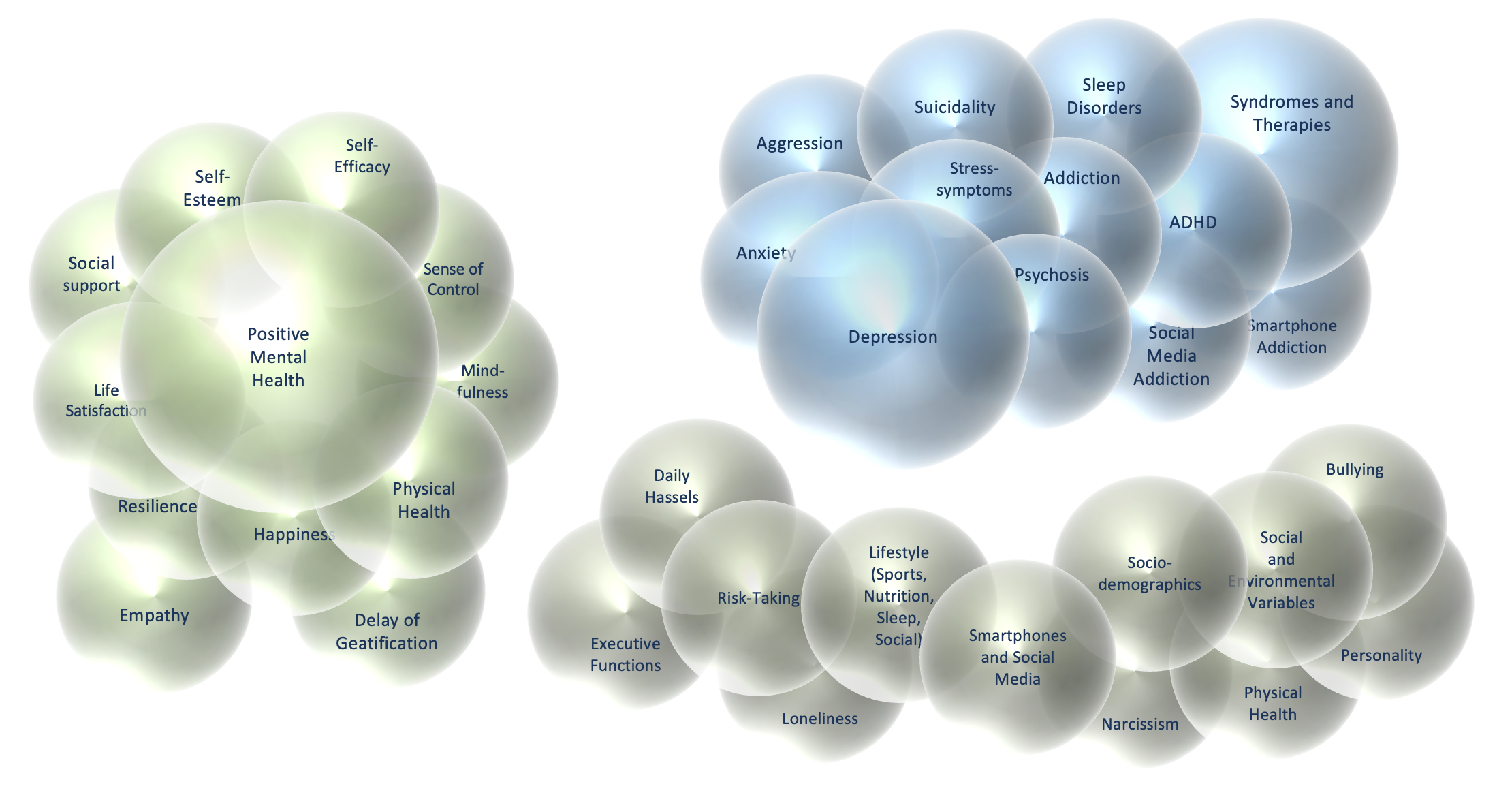
The COVID-19 pandemic has highlighted both the value and the shortcomings of digitalization in Germany. These also affect the healthcare system and the treatment of mental disorders such as anxiety, depression, and addiction, which are of high socioeconomic relevance due to massive increases in work absences and early retirement, and place a heavy burden on those affected, their families, and society as a whole. The negative psychosocial effects of the pandemic and recent political-economic crises are intensifying the urgent need for action. To meet the demands of the digital age, rapid and efficient methods for generating knowledge, as well as correspondingly short pathways for translating newly acquired knowledge into prevention strategies and therapeutic practice, are necessary. In terms of content, it is important to consider that mental health is more than the absence of illness. It is an interplay of negative factors, such as stress, and positive factors, such as life satisfaction. A mentally healthy person is characterized by low levels of negative factors and high levels of positive factors. Thus, an orientation toward both positive and negative factors in research and practice is necessary to do adequately address the multifaceted topic of mental health and to enable appropriate professional action. This is where the work of the Digital Mental Health Panel begins.
Objectives
The main objective of the Digital Mental Health Panel is to closely monitor mental health across its entire spectrum – including positive and negative factors – as well as its potential risk and protective factors in Germany, to track their development and interaction, and to enable causal research.
The implementation of the steps envisaged by the Digital Panel is intended to be fast, flexible, cost-effective, and representative. In this way, mental health care for affected individuals and their families in Germany will be improved, an early warning system for psychological distress in the population will be enabled, prevention programs to promote mental health will be developed and evaluated, and evidence-based policy decisions will be supported.
Key Research Methods
The achievement of these objects is accomplished through the establishment and long-term maintenance of the Digital Panel, within the framework of which diverse target groups are continuously recruited and monitored by regular online surveys and other online and offline assessment formats.
Target groups of the Digital Panel are the general population in Germany (approx. N = 100,000) as well as additional populations of special interest, particularly clinical patient populations or groups with specific risk or protective factors regarding mental health (approx. N = 50,000). Currently, the panel comprises approximately 30,000 individuals.
The regularly conducted online surveys comprise four types:
1. Baseline Assessment, conducted when a participant is first enrolled in the study (duration max. 30 minutes);
2. Core Repeated Assessment, conducted three times a year (duration max. 10 minutes each);
3. Annual Update Assessment, conducted once a year (duration max. 20 minutes);
4. Rapid Response Assessments, which can be initiated following international, national, or local events expected to have significant effects on mental health (e.g., natural or man-made disasters; duration max. 15 minutes each).
In addition to the online surveys, the Digital Panel conducts in-depth assessments (online or on-site at collaborating institutions) as well as preventive and therapeutic online and offline interventions. Through this novel combination of epidemiological surveys and mechanistically oriented (experimental/intervention) studies, the Digital Panel goes beyond previous panel and cohort studies and enables the systematic investigation of causal mechanisms in a longitudinal design. The diversity of constructs examined allows for a comprehensive examination of mental health and its influencing factors. The Digital Mental Health Panel is an infrastructure whose findings can be used by key stakeholders from academia, healthcare, and politics.
Project Team
Prof. Dr. Jürgen Margraf
Prof. Dr. Silvia Schneider
Apl.-Prof. Dr. Julia Brailovskaia (Coordinator)
Dr. Lena-Marie Precht
Pauline Schmidt, B. Sc.
Ricarda-Joy Naffin
Elisa Michels
> Back to the overview "Publications and Information for Researchers and Interested Parties"